Monday, September 12, 2016

Wednesday, February 4, 2015
Is vaccination a violation of our civil liberties?
I appreciate civil liberties more than the next guy, perhaps because I'm a libertarian and not an anarchist. What do we mean when we say we're free? Anarchists will say our freedom is "inherent" but this can't be right because freedom only means something in the context of having to live with other people. Where does your freedom end and mine begin?
We can only answer that question when we reach some agreement about what behaviors we're tolerate and protect. And we're obligated to protect each others' freedom, so freedom comes with responsibility. If I don't pay my taxes, I'll be sent to jail. If I don't fight for the country if I'm drafted to, I'll be sent to jail. If I resist being sent to jail, I'll be killed.
Now, I think our taxes are way too high and the government through which we establish and protect our freedom fights too much and imposes way too many restrictions on us. Mostly I think they're fucking idiots. But I'm obliged to these idiots nonetheless because the relative health, prosperity and freedom I enjoy is premised on us being responsible citizens and meeting the trivial responsibilities we have to each other.
The vaccination responsibility is trivial. I'm not asked to go to war. I'm not asked to believe in any particular religion. I'm just asked to take a couple seconds of minor pain and a trivial risk that I'm one of the 1 in 1,000,000 people who actually have a bad reaction. It's irrational to worry about this. Even with improved hygiene, thousands, probably tens of thousands would get sick and die without vaccines every year. The cost benefit to vaccines isn't worth talking about.. It'd be much more rational to complain that you're being taxed too much for shitty schools, worthless politician, enfeebling social programs, crony capitalism and needless wars.
Taking away my ability to provide for my family is a much greater obligation than getting a shot, and I think folks are giving in to baseless fear to put one in front of the other.
Wednesday, November 6, 2013
I'm a Libertarian in theory, but vote Republican because I want my vote to count.
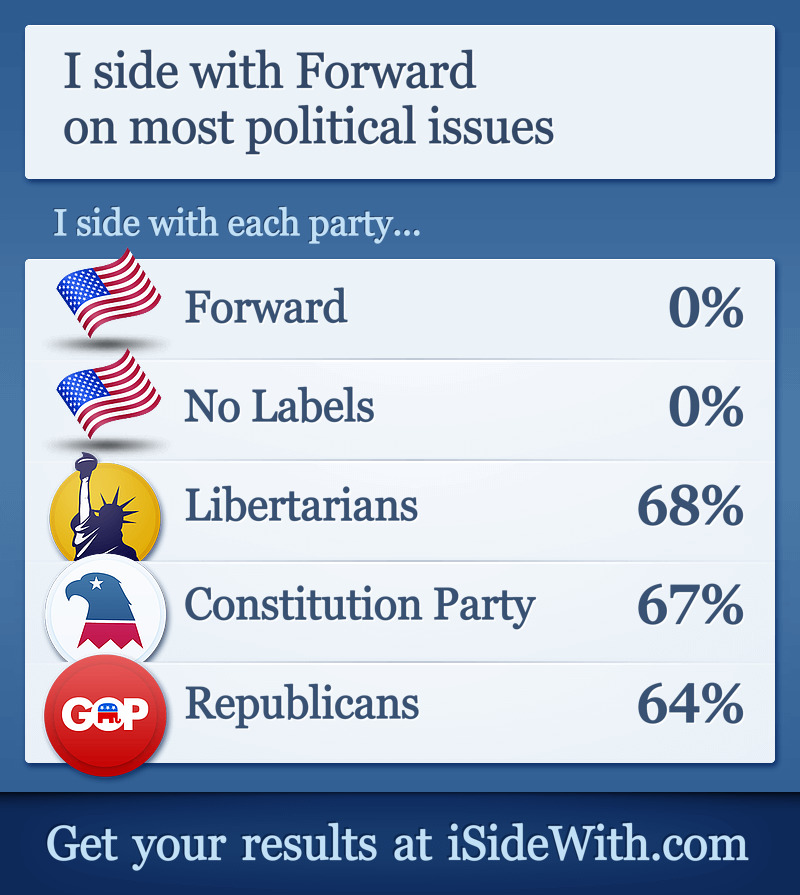
Just like real voting, our system sucks because people vote expressively (for what they feel) rather than instrumentally (to accomplish policy).
What's "important" should be:
1. How big is the issue? The death penalty affects a trivial amount of people, the Obamacare fiasco a huge amount of people.
2. How can the issue be resolved? While I might sympathize more with those who suggest Global Warming is a huge problem, the proposed solution of cap and trade is terrible while the GOP of encouraging market responses seems practical. Likewise, many of the "problems" don't need solutions imposed by the government, because cultural and social dynamics will resolve them no matter who's in power (e.g. Gay rights).
Monday, October 14, 2013
Intelligence is supposedly going to be explained here, but I think the purported criticisms to be explained are strawman versions of more substantive and hard to refute criticisms. I don't think intelligence is very useful as a practical matter because:
1. It is not necessary to assume we are all good at something to criticize the overall intelligence concept. Rather, it's enough to note that everyone has different relative strengths across their cognitive domains, and it's these variations, along with that 50% of ability that isn't "g-locked' and is somewhat variant, will often dominate the explanation.
The blogger says that intelligence exists to cope with uncertainty. To pull an economics concept into the discussion, intelligence by definition doesn't help one cope with something like Knightian uncertainty (an uncertainty that's simply not calculable in a meaningful way). More practically, how many philosophers does it take to screw in a light bulb? None, because it's not a problem that requires a philosopher. There are a lot of ways to resolve life's many uncertainties, and it's not always evident that throwing more intelligence at the problem is the most efficient. Out of all the problems out there to be solved, a critical application of abnormal intelligence solves very few of them.
2. The brightest of us aren't as bright we might hope. And definitely not so bright as to rightly claim the prerogatives they have historically claimed. Simply put, the smartest of us frequently lie, cheat, steal and kill, and the dumbest of us frequently know when they're being lied to, cheated, stolen from, and killed.
3. “It is possible that clever people develop a kind of cognitive noblesse oblige; they kind of know they have won the lottery on a valuable trait, but they think it is bad form to acknowledge it.”
See 2. If you're truly smart, you ought to be smart enough to not go prattling on about it. And if you're truly smart and realize that the overwhelming majority of people are truly quite a bit less smart, you ought to be smart enough to understand they may not be smart enough to take your prattling on about it in stride.
Wednesday, October 2, 2013
...providing access to private healthcare insurance to the working poor is obviously the point of no return.
a black president doing something for black citizens (even though the vast majority of beneficiaries of Obamacare will be non-black). Andrew Sullivan - via Ann Althouse.
Of course, in reality the concern is that Obamacare's rules are basically creating a permanent caste system between the working poor and the working professional.
Under Obamacare the working professional gets heavily tax-subsidized employer-based insurance and the working poor get penalized if they do not buy insurance. And they get permanently routed to part-time jobs.
Basically, if you came up with a recipe to destroy the working class, you couldn't do a better job than Obamacare. So much for being a beneficiary.
Thursday, September 26, 2013
People like the debt ceiling and they should.
People like the debt ceiling (although Tyler Cowen doesn't).The debt ceiling is useful precisely because it forces both voters and representatives to at some level confront and resolve the cognitive dissonance between "I want to spend all this money" and "I don't want to be at an unsustainable debt level".
The debt ceiling makes more sense, not less, in light of both behavior economics and public choice lessons.
The debt ceiling makes more sense, not less, in light of both behavior economics and public choice lessons.
Wednesday, September 26, 2012
The Presidential options on foreign policy
David Henderson thinks Obama will be re-elected due to foreign policy. In his post he argues Governor Romney would be the "war candidate". But there's no quotes from Romney or even outlines of his statements or thinking in any real detail. Nothing at all but vague assertions and implications.
How about some specifics. In the comments to that post, Greg G says:
But... I don't interpret either of those specifics as favoring military action nor do I think he's unambiguously more "warlike" than Obama's policies. Rather, both cases relate to the feeling that Obama is sending the wrong signals to our friends and enemies around the world.
Foreign policy largely seems like a signaling game to me. Sometimes conflicts might be unavoidable, but history shows that lots of conflicts arise from misunderstanding the signals both our friends and enemies send. In that vein, once you've reached the stage of armed conflict, you've already lost.
Put simply, it's wise to tell an enemy you'll hit them back with overwhelming force if they attack. If an enemy questions your will to fight, it's wise to give every appearance that you'll fight and fight forever, even if you don't want to.
With respect to friends, giving them ambiguous signals of support is also dangerous. If your friend starts a fight, do you have his back? Will he start the fight if you say you don't? Will the enemy start a fight with your friend if he thinks you'll jump in? How about if he thinks you'll sit it out and let the friend go it alone?
All of this is pretty common sense stuff from both an every day perspective and a foreign policy perspective. And to my mind, Romney's specific criticisms are pretty valid. We very well might avoid (more) war by signaling our endless resolve to our enemies and communicating our exact intentions to our friends, regardless of what we actually intend.
2. The article that David links to calling the Romney advisors "neo-con retreads", in fact, doesn't call any of the advisors neo-cons. In fact, it says of his closest and most well-known advisors:
Zoellick: "He is a generally regarded as a relative moderate on foreign affairs, a pragmatism, at the other end of the spectrum in the Republican party from the neocons."
Williamson: "He is a state department veteran who served in the Reagan administration and during the George W Bush administration opted to concentrate on the Darfur crisis in Sudan rather than become bogged down in the Iraq war. One of his jobs is to co-ordinate the divergent views coming from Romney's 40-plus pool of foreign policy advisers."
Kagan: "One of the best-known thinkers in US foreign policy and a heavyweight adviser to Romney. He was a foreign policy adviser to John McCain in his bid for the Republican presidential nomination in 2008. He is co-founder of the neo-conservative Project for the New American Century. In spite of that, he is not generally regarded as a neo-con but a realist. His latest book, The World America Made, was praised by Barack Obama."
Friedberg: "Professor of politics and international relations at Princeton. Another realist has focused recently mainly on the rise of China and argues that the Obama administration should be preparing for a potential conflict. In spite of that, he does not believe such a conflict is inevitable."
3. I don't understand why David is asserting that immediately withdrawing from war and the Middle East would be a winning strategy while posting links to public opinion research suggesting that majorities of voters support the policy of continued war offered by President Obama.
How about some specifics. In the comments to that post, Greg G says:
It is quite true that there is a lack of policy specifics that we have "heard from Romney." One specific that we have heard is that he is outraged that Obama has not been more supportive of the current Israeli government which is seeking our support in attacking Iran.
That has been the specific that he has chosen to emphasize the most. He has also criticized Obama for being willing to announce a specific date for leaving Afghanistan.
But... I don't interpret either of those specifics as favoring military action nor do I think he's unambiguously more "warlike" than Obama's policies. Rather, both cases relate to the feeling that Obama is sending the wrong signals to our friends and enemies around the world.
Foreign policy largely seems like a signaling game to me. Sometimes conflicts might be unavoidable, but history shows that lots of conflicts arise from misunderstanding the signals both our friends and enemies send. In that vein, once you've reached the stage of armed conflict, you've already lost.
Put simply, it's wise to tell an enemy you'll hit them back with overwhelming force if they attack. If an enemy questions your will to fight, it's wise to give every appearance that you'll fight and fight forever, even if you don't want to.
With respect to friends, giving them ambiguous signals of support is also dangerous. If your friend starts a fight, do you have his back? Will he start the fight if you say you don't? Will the enemy start a fight with your friend if he thinks you'll jump in? How about if he thinks you'll sit it out and let the friend go it alone?
All of this is pretty common sense stuff from both an every day perspective and a foreign policy perspective. And to my mind, Romney's specific criticisms are pretty valid. We very well might avoid (more) war by signaling our endless resolve to our enemies and communicating our exact intentions to our friends, regardless of what we actually intend.
Sunday, September 16, 2012
A bad thing happened
Some things should be put simplistically because they are, at heart, very simple. Because they're core truths.
1. Our freedom of speech is near absolute. Our government's stated purpose is largely to protect it. Plumbing the intent of a citizen's speech, subjecting him or her to criminal investigation because of it, or using government power to identify a citizen to those angered by the speech is unconscionable.
1. Our freedom of speech is near absolute. Our government's stated purpose is largely to protect it. Plumbing the intent of a citizen's speech, subjecting him or her to criminal investigation because of it, or using government power to identify a citizen to those angered by the speech is unconscionable.
2. It is also particularly foolish when it comes to people who appear to want to be angered or offended. Can anyone suggest a remotely workable way in which Americans would be able to exercise our core freedoms without fear of giving offense to these sort of folks? I don't. Sometimes people need to step back from the minutiae and look at the big picture.

Saturday, June 9, 2012
Why Do People Talk About Means Testing of Social Security?
I don't understand why anyone would waste time talking about this.
Social Security is already means tested; every dollar of SS benefits is considered taxable income.
Thus, much of the benefits that accrue to rich beneficiaries is already recovered by the government. What's the point of arguing about the accounting mechanics of it, which are almost entirely government accounting fictions. (If the government chose to, it could certainly classify some of those tax revenues as recapture of social security, but so what?)
And sure, it's inefficient to cut a check and then have everyone send some back later (although in a world of electronic deposits, it's not that inefficient) there's also the advantage that this form of "means testing" via the income tax should generally work in favor of people who actually get themselves stuck in bad situations- i.e. a rich senior who has a sudden fall in income (perhaps they invested in GM or Chrysler bonds) will automatically be supported through the current situation.
Alternatively, under means testing, the same person would presumably have to go fill out some kind of paper work, have their new and additional benefit levels approved but a complicated and expensive bureaucracy. And how would you measure prospective income anyway- isn't it inherently more difficult than simply seeing what your income actually was over the course of a year? It sure is to me. I guess you could save some money by making the means testing rule based on past income only, but of course that will generate significant hardship exactly the sort of people (those who suddenly lose income) we're setting things up to try and help.
So basically, no offense, this is yet another situation in which our seemingly insane government has evolved to a more rational, flexible outcome than a comprehensive and purely rational approach would likely get to.
Tuesday, September 27, 2011
We want our politicians to be good liars
OK, assume the worst intentions (which I don't, but for the sake of argument) it's still better to have a competent liar than an honest fool.
And, by the way, counld someone write an entertaining account for us of what one of those monthly Obama-Bernanke meetings sounds like?
- Party R holds the true belief but the voting public holds the false belief. Party R must lie to win the election and implement their true belief.
- Party D holds the false belief and is in power. They have steadfastly refused to question their false belief to their own and their country's great detriment.
And, by the way, counld someone write an entertaining account for us of what one of those monthly Obama-Bernanke meetings sounds like?
Thursday, September 22, 2011
John Taylor: Abandon the employment goal to reach it
Scott Sumner posted on John Taylor's piece in Bloomberg the other day, and thinks it says Taylor is calling for tight money. I just re-read Taylor's piece, and I don't think he's arguing for a cut in inflation targeting or tight money.
Why has the Fed gone cuckoo over interest rates? I mean, they’re doing crazy stuff to further lower them!
It's because they are focused on employment! To the detriment of hitting their price stability target. Because they’re totally locked in on the wrong concept to the exclusion of all else. Why? because our basic economic theory, the sort we teach and learn in econ 101, and that even most non-economists intuitively understand, is that low interest rates lead to more borrowing which leads to more employment.
Taylor is saying this pursuit of the the unemployment mandate, to the exclusion of everything else, is counterproductive to reducing unemployment.
Why Bernanke and co don’t understand low rates aren’t the solution to this kind of problem, I don’t understand, but I do understand the situation when I view it from that perspective.
Not will low rates not work in this situation, they focus and background conditions cause the Fed to ignore price stability and allow deflation. Which, of course, kills employment.
By abandoning the employment goal, the Fed gets to stop caring about interest rates and focus on the price level. Which will help the now unstated employment goal.
It's elegant, ingenious, and it might actually be right.
Wednesday, September 21, 2011
Will Obama be the 2012 Democratic Nominee?
Ann Althouse surveys articles talking about this and says:
I'm sorry, I can't see the Democratic Party thriving by ousting Obama. What chaos! And Hillary would have to compete in the primaries. Presumably, other Democrats — those characters who are otherwise waiting for 2016 — would jump into the fray. (But who are those other Democrats? What is the next wave of presidential-seeming Democrats?) I think it would be an awful mess if he were publicly hounded into withdrawing.
If some powerful alliance of liberals really wanted Obama to withdraw, they would — I imagine — be operating in private. It would be handled in a way that would preserve Obama's ability to come forward and present his withdrawal in a very grand and lofty style, as a matter of his own decision and not out of desperation and for highly altruistic reasons.
I agree that the Democrats wouldn't stand a chance by challenging him, but I don't see any logic to some secret cabal operating in private. Suppose he resigns or chooses not to run. What on earth does his Democratic successor run on? The successor can't do much to change policy over the next year, and the economy sucks. Nobody wants to step up and own that.
So why do we see media outlets talking about this like it might happen? Because non-stories are popular. Up next, Pete Rose should be in the Hall of Fame!
Tuesday, September 20, 2011
What should the Fed do?
Is it treasonous to believe what might be the right policy in the abstract would be the wrong policy in practice?
* Can the Fed be trusted to get things right on its own? With 2008-present as evidence, even though I favor targeting a higher NGDP rate instead of 2% inflation, I see a real possibility for them to botch it badly, and for things to get out of control.
* The Fed ultimately relies on its credibility and the expectations of the larger public to act to do this, and memories of the 70s and 80s inflations scare the hell out of people. The real and perceived actions of the Fed in 2008 to present don't add to its credibility.
* If we have a President who fundamentally misunderstands economics but nonetheless holds a lot of both hard and soft power, he could cause a lot of really bad things to happen. Another year of this would suck, but the current situation doesn't portend riots, bloodshed, wide-spread class warfare, constitutional crises, or government defaults.
In short, lots of "very bad things" could happen if the Fed acts in a significant way, and having them not happen depends on lots of people with differently aligned interests all acting in concert. In an election year.
Obama's grasp of economics and social graces
From Althouse, we apparently the President's first words to former economic adviser Christina Romer were:
While the language is bad the bigger problem is that Obama was meeting one of the world's foremost scholars of monetary (and fiscal) policy and immediately dismissing one of her primary findings.
It'd be like meeting Einstein and the first words out of your mouth are "relativity is bullshit".
""It’s clear monetary policy has shot its wad" is what Obama said to her before even "hello."Stay classy, Barack! Worse, as an economist, she was clearly right and Obama (and the Larry Summers faction of economists he sided with on monetary policy) was plain old wrong, and have made things much worse following their mistaken beliefs.
While the language is bad the bigger problem is that Obama was meeting one of the world's foremost scholars of monetary (and fiscal) policy and immediately dismissing one of her primary findings.
It'd be like meeting Einstein and the first words out of your mouth are "relativity is bullshit".
Are we truly indifferent between inflation options?
A standard experiment for seeing if people suffer from money illusion is to ask them whether they’d prefer a nominal wage increase with higher inflation or a nominal wage cut with lower inflation in the manner of Kahneman and Thaler’s surveys. Right?
When respondents prefer the nominal wage+inflation hike, it’s cited as evidence of peoples' irrationality. For instance a typical survey question asked:
"A company is making a small profit. It is located in a community experiencing a recession with substantial unemployment [but no inflationland inflation of 12%]. The company decides to [decrease wages and salaries 7%lincrease salaries only 5%] this year.”
Respondents considered the wage decrease worse than the wage increase, although after adjusting for inflation they're equivalent. In a world where Y=C, then they’re equivalent. But in a world where Y=C-S, and we can generate a better than inflation return on S, it’s better to have the nominal wage hike.
Simple math. I earn $1000 this year and save $100 of it. The other $900 is consumption. I’m offered Kahneman’s choice for next year.
- If I choose a 7% cut + 0% inflation, I earn $930 and spend $900. If I’d had the $100 of savings invested in TIPS at a .07% plus inflation, I end the year with $130 in the bank which is about 14% of my annual expenditures.
- If I choose a 5% raise with 12% inflation, I earn $1,050 and consume $1,008, so I can add another $42 to my savings. That $100 of savings invested in TIPS at .07% plus inflation yields $112, so I end the year with $154 in the bank which is about 15% of my annual expenditures.
IE, the two choices are *NOT* equivalent in real terms and workers are right to prefer the nominal wage increase+inflation option. It's a small difference here, but we're only talking about a 1 year change and a tiny investment return above inflation. As you project it out over longer periods, you get a better real return in the inflation adjusted situation.
Friday, September 16, 2011
Libertarians and Pricing
Noapinion (via the Money Illusion) thinks more liberty means annoying prices on everything.I think the key misunderstanding is found here:
A “progressive” society has increased incentives to nickel and dime over a “libertarian” society, because the former is subject to many more non-market price distortions that need to be compensated for in order to turn a profit.
Intuitively, this makes a lot of sense: if the government can come and confiscate your stuff, or tell you what to do with it, you don’t feel very free at all. But libertarians tend to take this basic concept to its maximal extent; the more things are brought within the cash nexus, the more free we become. No limits, no exceptions. A direct implication is that the more government functions we can privatize, the more free we will be.
First, a libertarian would stop at the first sentence. That’s freedom of contract and property. But nothing about the freedom of property or contract requires you to monetize everything, and in fact such a requirement would diminish freedom.
Second, although it does not follow that bringing everything into the “cash nexus” is optimal, the real problem we have here is that Noah really misunderstands the Economist’s argument here, which is for traditional contractual relationships and property rights in health care, not overzealous itemized billing.
The big irony, of course, is that the most obvious caricatures of “monetized everything” seem to spring out of heavily regulated and government run industries, which divorce the consumer more than usual from choice and direct payment for services. Hospitals charging $20 per aspirin, for instance, isn’t a libertarian or market outcome, it’s a regulatory outcome.
Put simply, pricing exists under every system. Libertarians argue for maximal contract and property rights, which will generally lead to efficient pricing. And nickel and diming everyone to death is generally not very efficient unless you’re severely restricted in your alternatives as a producer and your consumers are likely severely restricted in their alternatives to coming to you.
A “progressive” society has increased incentives to nickel and dime over a “libertarian” society, because the former is subject to many more non-market price distortions that need to be compensated for in order to turn a profit.
Monday, September 12, 2011
What are universities good for?
Universities produce four basic things for their customers:
- A Consumptive knowledge good (things we enjoy learning about).
- A Productive knowledge good (Human capital in the traditional sense of boosting our skills as workers).
- Social capital (in the sense that we gain lots of productive social interactions and contacts in our university experience).
- A signal of our existing stock of human capital (this is not developing new human capital - think of our transcript as a stamp on our foreheads showing the world how smart we are, not what we learned).
Breaking these down, I think it's remarkably difficult to say a university education is worthwhile for most individuals but for point 4. And obviously signalling is a good reason for individuals only given an inefficient collective equilibrium. There are much cheaper ways to send signals.
Points 1 and 2 are legitimate reasons to go to college, but I don't see how they'd justify the expense in many cases. Recently, I read someone arguing that college should also be understood in the context of point 3, but that seems way off base to me.
Universities are not somehow unique in their ability to create that social capital. You get all the same sort of things in work environments, sports and hobby clubs, religion, you name it. You can get much of the same by working with other students even in non-traditional classes.
Granted, it's a different way of thinking, but that's exactly the point. All of those social interactions can provide equivalent or better opportunities for social capital development (I'd argue for better, because they generally are truly collaborative, voluntary interactions, often across large peer and non peer groups).
And best of all, they're largely efficient, market-based interactions rather than an ungodly expensive university experience that saddles the kid with a lifetime of debt and a bunch of nonsensical ivory tower hokum.
Point blank, I certainly made great friends in college and grad school, and learned how to interact with them. However, I think I would have made great friends and learned how to interact with them in a world where most people don't go to college but, say, do extended apprenticeships or go to work in a factory. I also made great friends and developed relationships being a young, 20-something professional working with lots of other young, 20-something professionals and lots of older, more experienced folks too.
One final note. This is especially true with non-peer groups and diversity. University experiences with this seem uniformly bad (in my observations as a teacher and a student there). I learned a lot more about class, race and gender/sexuality relations (at least in the positive sense of developing relationships and working with folks of other races and backgrounds) by working, following my interests, volunteering than through anything I did at school.
Friday, September 9, 2011
Payroll tax cuts in the Obama Jobs Plan
I don’t see any wisdom in another payroll tax cut. Perhaps I’m too unsophisticated to see the way around these obvious problems I see everyone collectively ignoring:
* It further balloons the structural deficit, bringing what was once described with unintentional hilarity as a “long-term” problem and is now described as a “medium-term problem that much closer to term.
* It creates further inevitable fighting over whether it’ll become permanent.
* By virtue of being temporary, it loses a big chunk of its supposed stimulative oomph.
* It sets up yet another ridiculous political fight, whereby, at their most sensible, the Republicans would argue for a cut on the business side, and then be pilloried by Democrats for turning a tax cut on “workers” into a tax cut on businesses”.
* Even notwithstanding all of those show-stopping problems, it’s extremely doubtful to me that the empirics are on its side. It won’t help employ “millions” of currently unemployed workers. Certainly not in the current monetary policy environment.
* Bonus: consider where the labor market is really slack. Unemployment among highly skilled workers is about 5% and among low skilled workers is something like 15%. Over the last few years, we’ve driven up the minimum wage by over 20%, and the looming effects of the Obamacare legislation are projecting to add another 50-75% on top again over the next couple years. In that context, I don’t see how anyone can think a 2% reduction in the payroll tax, obtained at great expense in terms of regulatory, political, and long-term economic costs, makes any sense at all. It's pissing in the wind at the absolute best. I should also note that was by far the best proposal in his speech last night.
More on the ideal monetary regime
Building on my previous post, I see two major components to Scott Sumner's ideal monetary regime, and I think the emphasis is largely on the wrong one. That is, yes, NGDP targeting is maybe/probably better than inflation targeting, but it's still a system where political appointees take a swag at the target. Saying the actual target doesn't matter is not an ok answer.
That's why the futures market is such a great idea. With an NGDP futures market, it's automatic and self-correcting. We can't screw it up.
Put another way, the monetary crisis since 2008 hasn't been due to inflation targeting. It's been due to missing the inflation target. Human error. Replacing inflation targets with NGDP targets doesn't get us very far if we're still relying on an extremely fallible set of people to make the decisions.
Beyond that, while we really don't know what the hell we're doing when it comes to inflation targeting, there's at least pretty substantial research (and more here)on the question of what the target should be. Which is, you know, a better start than "the actual target doesn't matter".
Thursday, September 8, 2011
Everyone loves NGDP Targeting
One question I'd like settled before the Fed (as a collection of interested parties)- rather than a notional futures market - engages in NGDP targeting is how to set the target. Without hand-waving, can anyone reasonably say why a 6% target is the right target and not 7%? How's about 10%? I mean, if we want more growth, why not?!
It's not hard to see where this would go. Replace all the above-mentioned political hand-wringing about multipliers and GM with political pressuring for "just a little bit more" income and jobs. That could be a hell of a Pandora to let out of the box in any case... but especially if our theory of target-setting is essentially taking a swag.
Subscribe to:
Posts (Atom)